Your knee locks, catches or blocks so that you cannot fully straighten it.
You have a meniscus tear that is repairable — particularly if you are young, because keeping meniscus protects the joint for decades.
A loose fragment of cartilage or bone is floating in the joint and jamming it.
Mechanical symptoms persist despite a proper course of rehabilitation.
A cartilage flap or defect needs assessing and treating directly.
It is probably not right if…
Your main problem is established arthritis with pain but no locking or catching. Arthroscopy has been shown repeatedly not to help this, and it is not offered for it.
The pain is diffuse and worse with rest, without any mechanical symptoms.
You have not yet completed a proper course of physiotherapy for a degenerate tear that may well settle.
The knee is very stiff and swollen — this is settled first.
What arthroscopy actually is
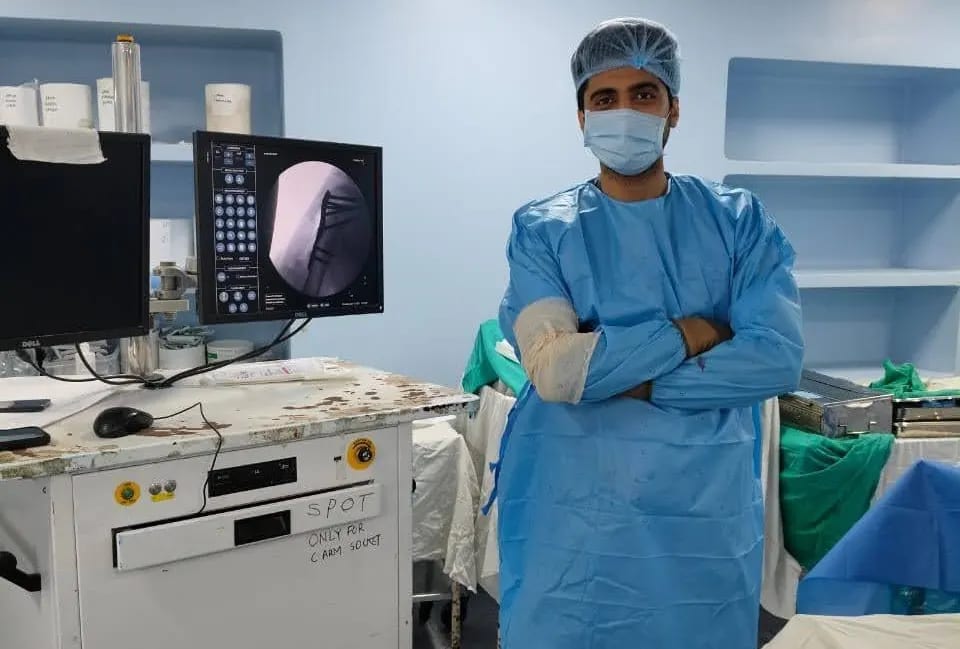
Arthroscopy means looking inside a joint with a camera. Two small openings are made either side of the kneecap tendon — one for a camera about the width of a pencil, one for the instruments. Sterile fluid gently expands the joint so everything can be seen. On the monitor the inside of your knee appears magnified and lit, in far more detail than an MRI can show.
Because the joint is not opened, the muscles and the capsule around it are left almost undisturbed. That is why most people walk out the same day.
The view from inside the joint. Magnified and directly lit, the arthroscope shows cartilage surfaces and meniscus tears in more detail than any scan.
The meniscus, and why we try hard to keep it
Each knee has two menisci — C-shaped wedges of tough cartilage that sit between the thigh and shin bones. They spread your body weight across the joint surface and act as shock absorbers. Remove a meniscus and the same load is concentrated onto a much smaller area of cartilage, which is why the knees of people who had a full meniscectomy decades ago often develop arthritis early.
Aspect
Meniscus repair
Partial meniscectomy (trim)
What happens
The torn edges are stitched together and left to heal
The torn, unstable fragment is removed and the rim smoothed
Meniscus kept
Yes — all of it
The damaged part is gone permanently
Crutches
4–6 weeks, often partial weight
1–3 days
Brace
Usually, for about 6 weeks
No
Back to desk work
2–3 weeks
3–7 days
Back to sport
4–5 months
6–8 weeks
Long-term joint protection
Much better
Load concentrates on less cartilage
Repair and trim are genuinely different operations with different recoveries.
If you are in your twenties or thirties with a repairable tear, the extra three months of recovery is a good trade for the meniscus you keep. If you are older with a degenerate flap that is catching and no realistic prospect of healing, a small trim to remove the mechanical problem is the sensible answer.
What else can be treated at the same time
Removing loose bodies — fragments of cartilage or bone that jam the joint.
Trimming an unstable cartilage flap that is catching on movement.
Treating a cartilage defect by microfracture or a cartilage restoration technique.
Releasing scar tissue in a knee that has become stiff after injury or previous surgery.
Taking a biopsy of the joint lining where inflammation is suspected.
Reconstructing the ACL, when the ligament is torn as well.
Where arthroscopy honestly does not help
This is worth saying clearly, because knee arthroscopy has been over-used for years. Large, well-conducted trials have shown that for knees with arthritis and pain but no locking or catching, arthroscopic washout and trimming performs no better than physiotherapy. If that is your knee, an arthroscopy will put you through an operation for no gain, and you will not be offered one here.
Risks
Swelling for a few weeks, which is expected rather than a complication.
Infection, in well under 1 in 100 cases.
A blood clot in the leg — uncommon, and reduced by walking early.
Stiffness, particularly if movement is not worked on in the first fortnight.
A repaired meniscus that does not heal, in roughly 1 in 10 to 1 in 5 repairs, sometimes needing a further operation.
Numbness in a small patch of skin near a portal, which usually settles.
Persistent pain if the true source of the symptoms was arthritis rather than the tear — the reason for being careful about who is operated on.
What recovery actually looks like
Written as a plan, not a promise. Your own timeline will be adjusted to what is found during the operation and how you progress — but this is the shape of it.
Day 0–2
Home the same day
You will walk before you leave. Expect a dressing, some swelling and moderate discomfort. After a trim you can put full weight through the leg; after a repair you may be partial weight-bearing in a brace.
Walking before discharge
Ice and elevation four to five times a day
Ankle pumps and straight-leg raises started
Dressing kept dry
Week 1
Settling
Swelling peaks and then starts to fall. Most people having a simple trim are off crutches within a few days and back at a desk within the week.
Off crutches after a trim
Bending to 90 degrees
Knee fully straight
Back to desk work after a trim
Week 2–6
Strength and normal walking
After a trim, this is the main rehabilitation period and most people are back to full activity by six weeks. After a repair, you remain protected in a brace for around six weeks while the stitched meniscus heals.
Normal walking pattern
Static cycling
Quadriceps and glute strengthening
Driving — from 1–2 weeks after a trim, 6 weeks after a repair
Week 6–12
Back to load
After a trim you are generally back to sport in this window. After a repair, the brace comes off, full weight-bearing resumes and strengthening begins in earnest.
Return to sport after a trim, from around 6–8 weeks
Out of the brace after a repair
Progressive resistance training
Running reintroduced when strength allows
Month 4–5
Sport after a repair
A stitched meniscus needs time that no amount of enthusiasm shortens. Return to pivoting sport is cleared on strength and control, usually at four to five months.
Full squat without pain
Agility and change-of-direction drills
Strength within 10% of the other leg
Cleared for competitive sport
Patients who had this
Chose the longer recovery to keep her meniscus
“I was given a genuine choice: trim it and be back on court in six weeks, or stitch it and wait five months. It was explained that keeping the meniscus would protect my knee for the next forty years. At nineteen, that was not a difficult decision once someone actually laid it out.”
Aditi V., 19 · Badminton player, student
Surat · 10 months after treatment
Outcome. Arthroscopic meniscus repair rather than trimming. Six weeks in a brace on partial weight, full movement by three months, back to competitive badminton at five months with the meniscus preserved.
A consultation means your imaging on the screen, a plain explanation of what is actually wrong, and an honest opinion on whether you need surgery — including when the answer is no.