Your knee gives way, shifts or feels unreliable on turning, twisting or stairs.
You play or want to return to a sport that involves pivoting — cricket, football, badminton, kabaddi, tennis, dance.
You have a torn ACL alongside a repairable meniscus tear, where fixing both together protects the cartilage.
Your work is physical enough that an unstable knee is a safety risk.
You are young and want to protect the knee from the arthritis that repeated instability causes.
It is probably not right if…
Your knee is stable in daily life and you do not play pivoting sport — a well-run rehabilitation programme may be all you need.
The knee is still very swollen and stiff. Operating on a stiff knee produces a stiff knee; we settle it first.
You are not in a position to commit to nine months of rehabilitation. The graft does not decide the result on its own.
You have significant established arthritis in the same knee, where a different operation is the better answer.
What the ACL does, and what changes when it tears
The anterior cruciate ligament is a short, strong band running diagonally through the middle of your knee. Its job is to stop the shin bone sliding forwards on the thigh bone, and to control rotation. You never notice it working — until it is gone.
When the ACL tears, the knee usually still bends, straightens and takes your weight. That is why people are often told it is only a sprain. What is lost is rotational control. The knee behaves perfectly walking in a straight line, then gives way without warning when you turn, step off a kerb, or change direction on a pitch. Each of those episodes is a small injury to the meniscus and cartilage inside the joint.
Do you actually need surgery?
This is the question worth spending your consultation on, and the honest answer is that it depends far more on you than on the MRI. Two people can have identical scans and need entirely different things.
12 weeks of structured, supervised rehabilitation and review
Settle swelling, restore full movement, then operate
How the decision is usually made. Most people sit clearly in one column.
What happens during the operation
The torn ligament cannot be stitched back together, so it is replaced. A tendon graft is taken from your own leg, passed through tunnels drilled precisely into the thigh and shin bones along the path the original ACL took, and fixed at both ends. The whole joint is worked on through two small incisions with a camera — the graft site is the only larger cut.
1
Examination under anaesthesia
With the muscles relaxed, the knee can be tested properly. This confirms exactly how much instability there is before anything is done.
2
Arthroscopy
A camera the width of a pencil goes in through a 1 cm portal. The whole joint is inspected — the ACL, both menisci, the cartilage surfaces and the lining.
3
Anything else is treated first
If there is a repairable meniscus tear, it is stitched now. Preserving meniscus is one of the strongest predictors of a knee that is still healthy in twenty years.
4
The graft is prepared
A tendon is taken through a small separate incision, sized, and prepared to the right length and thickness for your knee.
5
Tunnels are placed
This is the part that decides the result. The tunnels must sit on the original ligament's footprints; a graft in the wrong place will stretch or fail however good the tissue is.
6
The graft is passed and fixed
It is pulled through, tensioned with the knee in the right position, and secured at both ends. The knee is then taken through its full range to confirm it is stable and does not catch.
Which graft — and does it matter?
Three grafts are in routine use. All three work. The choice is made from your sport, your build, your job and whether you kneel a lot, and it is a conversation, not a default.
Graft
Taken from
Suits
Trade-off
Hamstring
Two tendons on the inner thigh
Most patients; people who kneel for work or prayer
Slight hamstring weakness early on; needs dedicated strengthening
Bone–patellar tendon–bone
The middle third of the kneecap tendon, with a small block of bone at each end
High-demand pivoting athletes; revision surgery
Kneeling can be uncomfortable for several months
Quadriceps tendon
The tendon above the kneecap
Larger grafts; revision; when hamstrings are needed for sport
Newer in routine use; a slightly larger scar above the knee
The risks, stated plainly
ACL reconstruction is a reliable operation, and most people are glad they had it. It is still surgery, and you should know what can go wrong before you consent to it.
Stiffness or difficulty getting the last few degrees of straightening — the most common problem, and the main reason we insist on a knee that moves fully before operating.
Graft re-tear, in roughly 1 in 20 patients overall, and higher in athletes under 20 who return to pivoting sport early. Completing rehabilitation and passing return-to-sport testing is the single biggest thing that reduces this.
Infection, in well under 1 in 100 cases.
A blood clot in the leg. Uncommon, and reduced by walking on the day of surgery.
Numbness in a patch of skin below the incision, which is common, usually small and usually settles.
Kneeling discomfort, particularly with a patellar tendon graft.
Persistent aching or occasional swelling after heavy activity in the first year.
Why the rehabilitation matters more than the surgery
A well-placed graft in a knee that is not rehabilitated will fail. A well-rehabilitated knee with an adequate graft will usually do very well. The operation buys you the opportunity; the twelve weeks afterwards decide what you do with it.
You will leave hospital with a written, dated programme — not an instruction to rest. It sets out what to do each week, what you should be able to do before you progress, and when you will be reviewed. Return to sport is decided by testing, not by the calendar: strength within 10% of the other leg, hop and landing tests passed, and confidence on the pitch.
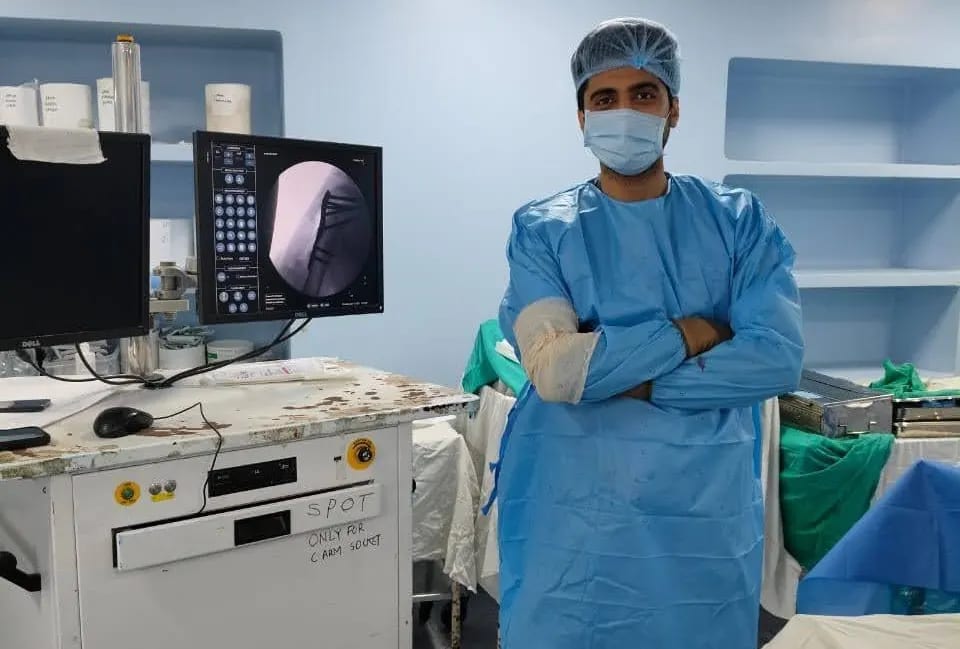
The arthroscope's view of the inside of the knee, on the theatre monitor. Everything except the graft harvest is done through portals about a centimetre across.
What recovery actually looks like
Written as a plan, not a promise. Your own timeline will be adjusted to what is found during the operation and how you progress — but this is the shape of it.
Day 0–3
Straight away
You will be up and walking on the day of surgery with crutches or a walker. Most people go home the next morning. The knee will be swollen and bruised; ice, elevation and pain relief are the priorities.
Walking with crutches on day one
Full weight through the leg unless a meniscus repair says otherwise
Straight-leg raises and ankle pumps started
Aiming to get the knee fully straight
Week 1–2
Movement first
The single goal is a knee that fully straightens and bends past 90 degrees. Everything else is built on this. Stitches or clips come out at about two weeks.
Full straightening achieved
Bending past 90 degrees
Off crutches indoors for most patients
Back to desk work
Week 3–6
Strength returns
Swelling settles and the quadriceps starts to switch back on properly. Static cycling, controlled leg press and balance work begin. Most patients are driving by six weeks.
Walking normally without aids
Full range of movement
Static cycling and pool work
Driving again
Week 6–12
Building a working leg
Progressive resistance work, single-leg control, and the beginning of straight-line jogging once strength and control allow it. This is the phase people are most tempted to rush.
Straight-line jogging
Single-leg squat with control
Return to physical work
Gym-based strength programme underway
Month 3–6
Agility and confidence
Change of direction, hopping, landing mechanics and sport-specific drills. The graft is at its biologically weakest around three to four months, which is exactly when it feels best — the reason for a structured programme rather than instinct.
Cutting and pivoting drills
Hop and landing tests
Non-contact training with the team
Strength approaching the other leg
Month 9–12
Back to sport
Clearance is by testing, not date. Returning before nine months, or before passing strength and hop testing, sharply increases the risk of re-tear.
Strength within 10% of the other leg
Hop and landing tests passed
Full contact training completed
Cleared for competitive play
Patients who had this
Back opening the bowling eleven months after his ACL went
“I heard the pop while turning for a second run and thought it was just a bad twist. Two months later my knee gave way on a staircase. What I remember from the consultation is being shown my own MRI and being told exactly what would happen at three months and at nine — including that I would feel fine long before I was ready.”
Rohit P., 24 · Club cricketer
Surat · 14 months after treatment
Outcome. ACL reconstruction with a hamstring graft, alongside repair of a meniscus tear found during the operation. Cleared to bowl at eleven months after passing strength and hop testing.
A consultation means your imaging on the screen, a plain explanation of what is actually wrong, and an honest opinion on whether you need surgery — including when the answer is no.