Sports medicine
Getting you back to your sport — safely, and once
Most sports injuries are re-injured because someone returned to play on a date rather than on a test. Care here is built around the opposite: objective clearance criteria, a written staged programme, and honesty about how long it actually takes.
Relevant training
- FIFA Diploma in Football Medicine
- Fellowship — Joint Preservation & Sports Medicine, Manipal Hospitals
- Fellowship — Arthroscopy & Sports Injury, Galaxy Hospital, Bhopal
- Fellowship — Sports Injury & Arthroscopy, Seattle Orthopedic Center
- ATLS certified
How it works
Four phases, in this order
The order matters more than any single step. Skipping phase two is the most common reason a technically good operation produces a disappointing result.
- Phase 1
Accurate diagnosis
Examination first, then the imaging that examination indicates. Not every painful knee needs an MRI, and the wrong scan can mislead as easily as inform.
- Phase 2
Restore, then decide
Swelling settled and full movement restored before any operation. Operating on a stiff joint produces a stiff joint — and some athletes never need the operation at all.
- Phase 3
Repair or reconstruct
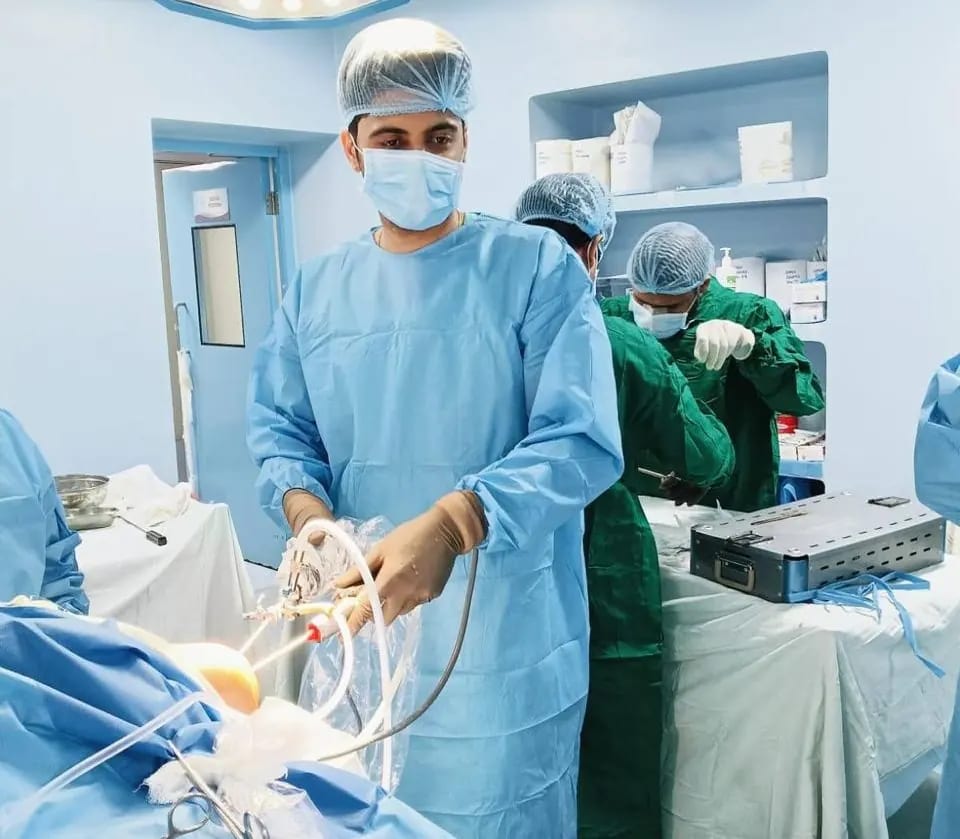
Where surgery is right, the emphasis is on preserving tissue: repairing the meniscus, repairing the labrum, restoring cartilage, placing the graft accurately.
- Phase 4
Tested, then cleared
Return to play on strength symmetry, hop testing and landing mechanics — plus your own confidence, which is data, not sentiment.
What is treated
Common sports injuries
Cricket, football, badminton, kabaddi, volleyball, tennis, running, dance and martial arts injuries — in professional and, far more often, amateur athletes.
Knee ligament injuries
ACL, PCL and multi-ligament injuries. The commonest reason a knee gives way when you turn.
Meniscus tears
Repaired rather than trimmed wherever possible — keeping the shock absorber protects the joint for decades.
Cartilage injuries
A defined defect in the joint surface, often after a kneecap dislocation or an impact injury.
Shoulder dislocation
The shoulder that keeps coming out. Highest recurrence risk in athletes under 25.
Rotator cuff injuries
Overhead athletes — bowlers, swimmers, volleyball and tennis players.
Hip impingement
Groin pain in a young athlete, frequently mistaken for a groin strain for years.
Return to play
Cleared on tests, not on the calendar
“Nine months” is not a rule invented to be cautious. After a ligament reconstruction the graft is at its biologically weakest at roughly the moment your knee starts to feel normal — which is exactly why the decision cannot be left to how it feels.
Before you are cleared, you will be measured. Where you fall short, you get more preparation rather than a pep talk.
Why nine months, in detailClearance criteria
- Quadriceps strength
- Within 10% of the other leg
- Hamstring strength
- Within 10% of the other leg
- Single-leg hop
- Within 10% of the other leg
- Triple and crossover hop
- Within 10% of the other leg
- Landing mechanics
- No inward knee collapse
- Single-leg squat
- No hip drop, no compensation
- Your own confidence
- You genuinely trust the joint
Prevention
The injury you avoid is the best outcome available
Neuromuscular warm-up programmes reduce ACL injury rates in pivoting sports by a meaningful margin. It is the least glamorous and most effective thing in sports medicine.
- A structured neuromuscular warm-up before training, not just a jog and a stretch.
- Landing mechanics — training the knee to track over the foot rather than collapse inwards.
- Hamstring and glute strength, which protect the ACL directly.
- Managing training load, particularly sudden increases at the start of a season.
- Not playing through a joint that swells after every session — that is a signal, not weakness.
- Addressing the other side after an injury, since a meaningful share of re-injuries happen in the uninjured leg.
Questions patients ask
Where to read more
- ConditionACL TearA torn ligament in the centre of the knee. It usually still walks fine — the problem is that it gives way when you turn.
- ConditionMeniscus TearA tear in one of the two cartilage shock absorbers in your knee. It catches, clicks, or stops the knee straightening.
- ConditionShoulder Dislocation & InstabilityOnce a shoulder has dislocated, the rim that holds it in place is usually torn — and it tends to happen again more easily.
- ConditionHip Impingement & Labral TearThe ball and socket pinch against each other because of their shape, tearing the cartilage rim. Commonly mistaken for a groin strain for years.
- TreatmentACL ReconstructionRebuilding the torn ligament in the centre of your knee so it stops giving way, using a graft passed through two small incisions.
- TreatmentKnee Arthroscopy & Meniscus RepairKeyhole surgery to see inside the knee and repair what is torn — most often a meniscus — through two incisions about a centimetre across.
- TreatmentShoulder Stabilisation & LatarjetStopping a shoulder that keeps dislocating — by repairing the torn socket rim, or by rebuilding the socket with a block of your own bone.
Injured, and want to know how long it will really take?
Bring your scans if you have them. You will get an honest timeline, a written programme, and a clear answer about whether you need an operation.