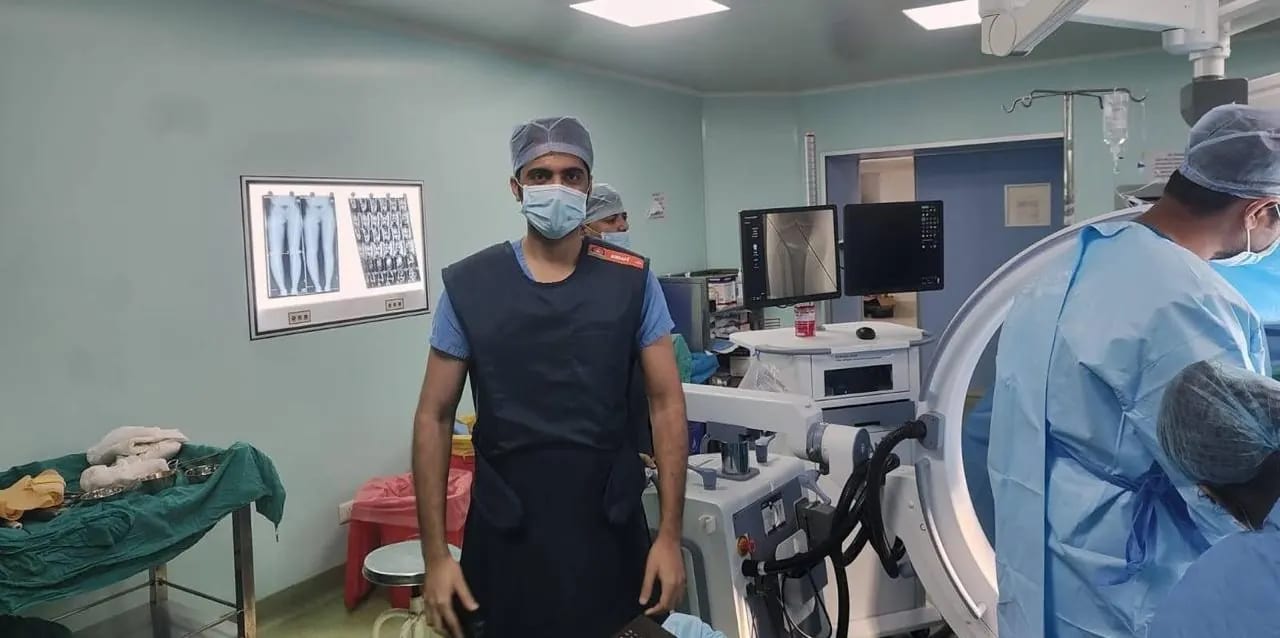
If you are in your forties or fifties, your knee hurts, and someone has shown you an X-ray and said the words 'you will need a replacement eventually', there is a question worth asking before you accept that: is my arthritis in one compartment or all of them?
The answer changes what is possible.
Arthritis is usually not evenly spread
Think of your knee as having three compartments: the inner half, the outer half, and the kneecap. In most people the inner half wears out first, and often it wears out alone for many years. The reason is alignment. If your legs are even slightly bow-shaped, more of your body weight passes through the inner side of the knee with every step you take — and you take several thousand a day.
It becomes self-reinforcing. The more the inner side wears, the more the leg bows. The more the leg bows, the faster the inner side wears.
The operation that interrupts the cycle
A high tibial osteotomy changes the angle of the shin bone by a planned number of degrees, so that load transfers from the worn inner compartment to the healthy outer one. The worn cartilage is not repaired or replaced. It is unloaded — and an unloaded joint hurts far less.
Nothing artificial goes into the joint. You keep your own knee, your own ligaments and your own cartilage. There is a plate and screws holding the bone while it heals, and many people keep those for life without noticing them.
The honest comparison
| Aspect | Osteotomy | Knee replacement |
|---|---|---|
| Best for | Under 60, one compartment worn | Over 60, or widespread wear |
| Your own joint | Kept | Resurfaced |
| Running and impact | Permitted | Discouraged |
| Heavy physical work | Permitted | Often limited |
| Crutches | 6–8 weeks | 1–3 weeks |
| Full recovery | 6–9 months | 3 months |
| Typical lifespan | 10–15 years, often more | 15–25 years |
| What comes after | A replacement remains possible | Revision replacement |
Why it is rarely offered
Three reasons, none of them about whether it works. It takes longer to plan, because the correction must be calculated in degrees from full-length standing X-rays. It takes longer to perform. And the recovery is much longer — six to eight weeks on crutches against one to three after a replacement, which makes it a harder conversation and a less popular operation.
It is also only right for a specific group. If your arthritis affects the whole knee, or you are over about sixty-five, a replacement is genuinely the better and more predictable operation and you should have one. The problem is not that replacements are over-used in general. It is that the alternative is often never mentioned to the people it would suit.
Why replacing too early is a real cost
An implant has a finite life. Roughly nine in ten knee replacements are still working at fifteen to twenty years. Have one at fifty, and there is a substantial chance you will need a revision — a bigger operation, with more bone loss and a less predictable result. Have one at sixty-eight and you will most likely never need it done again.
Buying ten or fifteen years with your own knee is not a delaying tactic. It can be the difference between one operation in your lifetime and two.
What to ask for
- Full-length standing alignment X-rays, not just a knee film. A short film cannot show your limb's mechanical axis.
- Which compartments are actually affected — inner, outer, kneecap, or a combination.
- Whether your alignment is contributing to where the wear is.
- Whether you are a candidate for osteotomy, partial replacement or total replacement, and why.
- If osteotomy is ruled out, the specific reason. 'You are better off with a replacement' is not a reason.