Groin or buttock pain that wakes you at night and no longer responds to painkillers.
Difficulty putting on socks, cutting your toenails or getting into a car.
Walking distance shortening to the point that it dictates what you do with your day.
A stiff hip that has begun to make you limp or has shortened the leg.
Avascular necrosis of the hip, where the ball has lost its blood supply and collapsed.
Arthritis after a childhood hip problem or a previous fracture.
It is probably not right if…
Mild arthritis where pain is manageable and walking is not limited.
Groin pain in a young adult from impingement with healthy cartilage — hip arthroscopy is the correct operation.
Active infection anywhere in the body, which must be treated first.
Pain that is actually coming from the spine rather than the hip, which examination and imaging will distinguish.
Why this operation has the reputation it does
Hip replacement is often described as the most successful operation in orthopaedic surgery, and the description is earned. Patients who have not slept properly in two years commonly report the night pain gone within days. Most are walking without a stick inside a month. Satisfaction rates are higher than for almost any other elective procedure in medicine.
The reason is mechanical simplicity. A hip is a ball in a socket, and both parts can be replaced with something that reproduces the original geometry closely. A knee has to balance ligaments through a complex arc; a hip largely just has to be round, correctly sized and correctly positioned.
What is replaced
The worn ball at the top of the thigh bone is removed and replaced with a smooth ball on a stem that sits inside the bone.
The socket is prepared and a metal shell fitted, lined with a highly cross-linked plastic bearing or a ceramic one.
The bearing surfaces are chosen for your age and activity — modern plastic and ceramic combinations wear at a small fraction of the rate of older materials.
Implants are either press-fit so bone grows into a textured surface, or cemented, depending on your bone quality.
Leg length is measured and corrected during the operation, which for many patients removes a limp they had accepted as permanent.
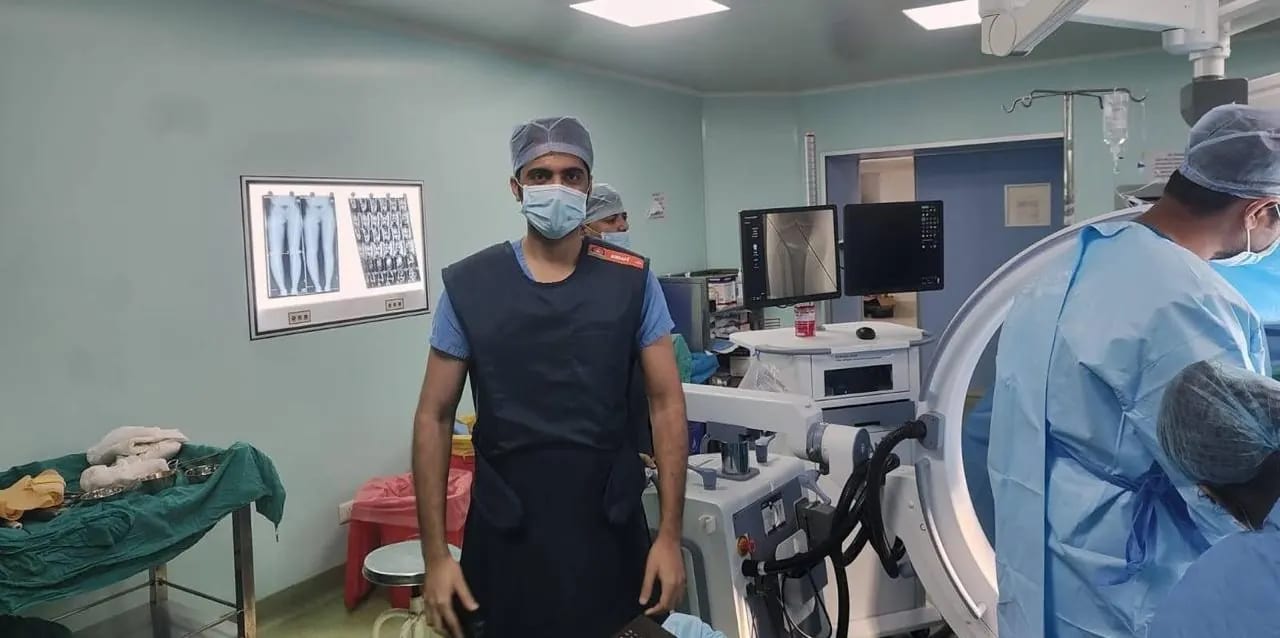
Live imaging in theatre confirms implant position and leg length before the wound is closed, rather than leaving either to be discovered on a post-operative X-ray.
When to have it done
The most common regret patients express is not that they had it done, but that they waited so long. That said, an implant has a finite life, so there is a genuine balance to strike.
Reasons to go ahead
Reasons to wait
Pain is waking you at night
Pain is controlled with simple painkillers
Walking distance is dictating your life
You are still doing everything you want to
You cannot put on your own socks or shoes
You have not tried a proper strengthening programme
Painkillers are needed daily
Weight loss is likely to make a real difference first
You are becoming less mobile and less independent
You are very young, and each decade of delay may save a revision
Risks
Infection, in roughly 1 in 100 to 1 in 200 cases. Prevention is why you are screened, given antibiotics and operated on in a laminar-flow theatre.
Dislocation of the new joint, in around 1 in 100, most likely in the first three months, which is why precautions matter early on.
A blood clot in the leg or lung. Reduced by walking on the day of surgery and by blood-thinning medication.
A difference in leg length, usually small and correctable with a shoe insert.
Loosening or wear over many years, which may eventually require revision.
Fracture of the bone around the implant, either during surgery or later from a fall.
Nerve irritation causing numbness or, rarely, weakness in the leg.
Persistent pain in a small minority despite a well-positioned implant.
Precautions afterwards — for three months, not forever
For the first three months, while the tissues around the new joint heal into a stable envelope, you will be asked to avoid the specific combinations of movement most likely to dislocate it. After that, most people return to normal life with very few restrictions.
Avoid bending the hip beyond 90 degrees — no low chairs, low sofas or deep squatting.
Do not cross your legs, or twist on the operated leg while standing.
Sleep on your back or on the unoperated side with a pillow between your knees.
Use a raised toilet seat and a firm, high chair at home.
Take stairs one at a time, leading with the good leg going up and the operated leg going down.
Sitting cross-legged on the floor and squatting are usually best avoided long term — an important consideration to discuss if these matter for daily life or worship.
What recovery actually looks like
Written as a plan, not a promise. Your own timeline will be adjusted to what is found during the operation and how you progress — but this is the shape of it.
Day 0–1
Walking on the day
You will stand and take steps with a physiotherapist on the day of surgery. This is not bravado — early mobilisation reduces clots, chest complications and stiffness. A spinal anaesthetic means you are usually alert and eating within a few hours.
Standing and walking on day zero
Full weight through the leg
Eating and drinking normally
Precautions taught
Day 2–3
Home
Discharge once you can walk safely with an aid, manage stairs and get in and out of bed independently. Most patients are struck by how much less the hip hurts than it did before surgery.
Walking independently with a frame or crutches
Stairs managed safely
Getting in and out of bed alone
Home with a written exercise plan
Week 1–3
Rapid early progress
This is usually the fastest-improving phase of any joint replacement. Night pain from arthritis is typically gone. Walking distance grows daily, and most people move from a frame to a stick within two weeks.
Off the frame onto a stick
Walking outdoors
Wound healed and reviewed
Sleeping through the night
Week 4–6
Independence
Most patients put the stick down entirely. Driving usually resumes between four and six weeks, once you can perform an emergency stop comfortably. Desk work is realistic from around three weeks.
Walking unaided
Driving again
Back to desk work
Static cycling and pool walking
Week 6–12
Back to normal life
Precautions are relaxed at around three months. Walking distance, strength and confidence continue to improve, and most people describe themselves as back to normal by twelve weeks.
Precautions lifted
Return to physical work for most jobs
Long walks, travel, worship without difficulty
Swimming and cycling
Month 3–12
Settling for the long term
Strength keeps improving for up to a year. Low-impact activity is encouraged; running and jumping are discouraged to protect the bearing.
Full strength restored
Golf, cycling, swimming, hiking
Any limp resolved
Annual review to monitor the implant
Patients who had this
Walking to the temple again, three weeks after surgery
“I had stopped going out. I could not put on my own shoes and I had not slept properly in a year. I walked with the physiotherapist on the day of the operation, which I did not believe would be possible. Three weeks later I walked to the temple without my stick.”
Savitaben P., 71 · Retired teacher
Athwa · 13 months after treatment
Outcome. Total hip replacement. Walking with a frame on day zero, stick discarded at three weeks, precautions lifted at three months, independent and pain-free.
A consultation means your imaging on the screen, a plain explanation of what is actually wrong, and an honest opinion on whether you need surgery — including when the answer is no.