Trauma & fractures · Treatment
Fracture & Trauma Surgery
Fixing broken bones so they heal in the right position — including the complex and previously badly healed fractures that need reconstructing.
At a glance
- Anaesthesia
- Spinal, regional block or general
- Time in theatre
- 45 minutes to 3 hours, by injury
- Hospital stay
- Day case to several nights
- Bone healing
- 6–12 weeks for most fractures
- Weight-bearing
- From immediately to 6–12 weeks
- Full recovery
- 3–9 months, by site and severity
- Metalwork
- Usually left in place permanently
- Follow-up
- Serial X-rays until union is confirmed
This is usually the right operation if…
- A fracture that is displaced, angled or rotated and will not heal in an acceptable position on its own.
- A break involving a joint surface, where even a small step in the cartilage leads to early arthritis.
- An unstable fracture where fixation allows you to move and use the limb far sooner than a cast would.
- A fracture that has already healed crookedly and is now causing pain, deformity or loss of function.
- A fracture that has failed to heal at all — a non-union needing grafting and stable fixation.
- Multiple injuries, or a fracture around an existing implant.
It is probably not right if…
- A stable, undisplaced fracture in good position. Many breaks heal excellently in a cast or brace, and surgery would add risk without benefit.
- Certain fractures in children, where the growing bone remodels remarkably well without an operation.
- Fractures where the surgical risk outweighs the functional gain, which depends on your general health.
Not every fracture needs an operation
It is worth saying first, because it is the most common misunderstanding. A great many broken bones heal perfectly well in a plaster cast or a brace. Bone is one of the few tissues in the body that repairs itself back to full original strength, and where a fracture is stable and sitting in a good position, letting it do so is the right treatment.
Surgery becomes the better option when the position is unacceptable, when the fracture will not stay put, when a joint surface is involved, or when fixing it lets you move and use the limb weeks earlier than immobilising it would.
How fractures are fixed
- Plate and screws
- A metal plate contours to the bone and screws hold the fragments to it. Preferred where a joint surface needs to be rebuilt precisely, and around the wrist, ankle, elbow and shoulder.
- Intramedullary nail
- A rod passed down the hollow centre of a long bone and locked with screws at each end. Excellent for the thigh and shin because it shares load with the bone and often allows walking almost immediately.
- Screws alone
- For fractures where two clean fragments can be compressed back together, with the smallest possible exposure.
- External fixator
- A frame outside the skin, connected to the bone with pins. Used in severe injuries with damaged soft tissue, or as a temporary measure to stabilise a limb until definitive surgery is safe.
- Hemiarthroplasty or replacement
- For some hip fractures in older patients, and some complex fractures near the shoulder, replacing the broken end is more reliable than trying to rebuild it.
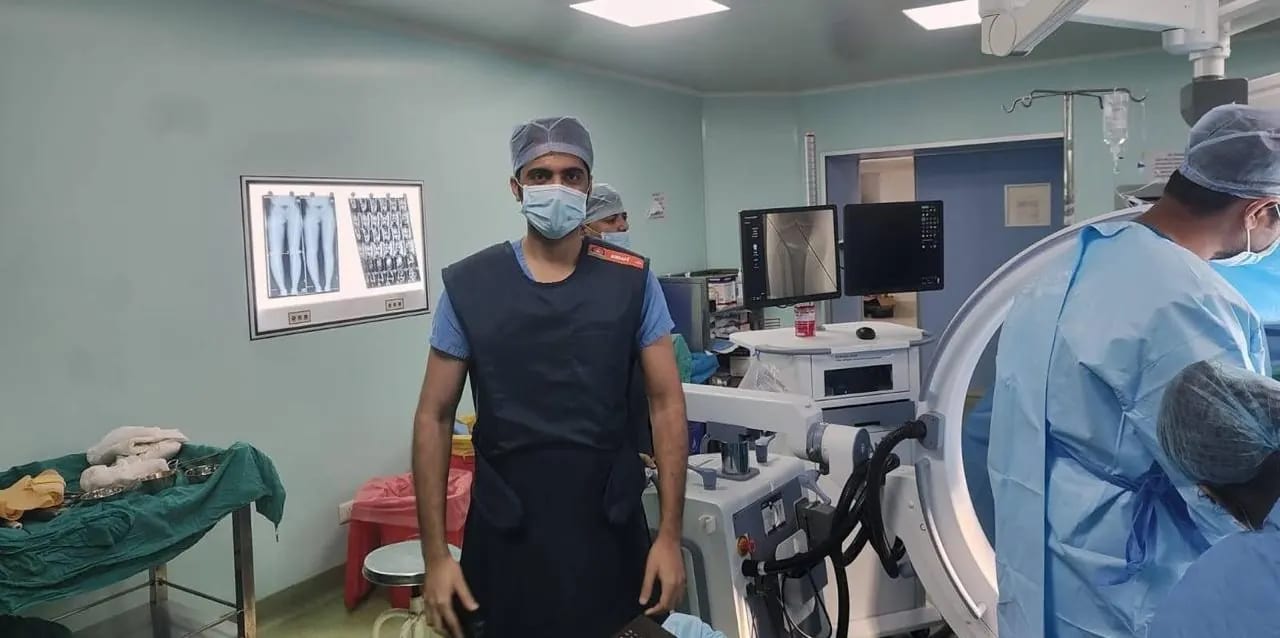
Most fixation is done with live X-ray guidance in theatre, which allows the fracture to be reduced and the position confirmed to the millimetre before anything is fixed — and, in many cases, allows it to be done through much smaller incisions than would otherwise be needed.
Fractures that were never fixed properly
A substantial part of complex trauma work is not fresh injury but its aftermath: a bone that healed in the wrong position, or never healed at all. Both are correctable, and both are worth having assessed even years later.
| Aspect | Malunion | Non-union |
|---|---|---|
| What happened | The bone healed, but crooked | The bone never united |
| Symptoms | Deformity, limp, altered gait, pain in the joints above and below | Persistent pain and movement at the fracture site months later |
| Treatment | Osteotomy — the bone is cut, realigned to a planned angle and fixed | The site is cleaned back to healthy bone, grafted, and fixed rigidly |
| Bone graft | Sometimes | Almost always |
| Healing time | 3–6 months | 4–9 months |
| Realistic goal | Restored alignment, protection of neighbouring joints | Union, and an end to the pain |
Risks
- Infection, which is more likely in open fractures where skin was broken at the time of injury.
- Delayed union or non-union, substantially more likely in smokers and in diabetics with poor control.
- Metalwork irritation, particularly where a plate sits close under the skin — the ankle, wrist and collarbone.
- Stiffness in the neighbouring joints, which is the reason movement is started as early as fixation allows.
- A blood clot in the leg after lower-limb injury or surgery.
- Nerve or blood vessel injury, uncommon but higher in complex and open fractures.
- Post-traumatic arthritis where a joint surface was involved, which good reduction reduces but cannot always prevent.
- The need for further surgery — graft, revision fixation, or removal of metalwork.
Things that genuinely change how fast you heal
- Stopping smoking. Nicotine constricts the small blood vessels that fracture healing depends on, and it is the single largest modifiable risk for non-union.
- Controlling diabetes. Blood sugar affects both bone healing and infection risk.
- Adequate protein, vitamin D and calcium — bone repair is a construction project and it needs materials.
- Moving everything you are allowed to move. Stiffness in the joints around a fracture causes more long-term trouble than the fracture itself.
- Attending every follow-up X-ray. Problems caught at six weeks are far easier to solve than problems found at six months.
What recovery actually looks like
Written as a plan, not a promise. Your own timeline will be adjusted to what is found during the operation and how you progress — but this is the shape of it.
Day 0–3
Immediately after fixation
Elevation and ice to control swelling, with pain relief. Depending on the fracture and the fixation, you may be allowed full weight through the limb straight away or asked to keep it protected.
- Limb elevated to reduce swelling
- Weight-bearing status made clear in writing
- Movement of neighbouring joints started
- Discharged with a plan and a follow-up date
Week 1–2
Wound and swelling
The wound is reviewed and stitches or clips removed at around two weeks. Swelling is at its most troublesome now and settles from here.
- Wound healed and reviewed
- Stitches removed
- Range of movement exercises underway
- First follow-up X-ray in many cases
Week 2–6
Early healing
Bone begins to bridge the fracture. Movement is progressed and, where the fixation allows, weight-bearing increases in defined stages guided by X-rays rather than by how it feels.
- Progressive weight-bearing where permitted
- Neighbouring joints moving freely
- Muscle strengthening started
- X-ray confirming early union
Week 6–12
Union
Most fractures show solid union in this window. Restrictions are lifted progressively and rehabilitation shifts from protection to rebuilding strength.
- Full weight-bearing for most fractures
- Walking aids discarded
- Return to desk work, and to many physical jobs
- Union confirmed on X-ray
Month 3–9
Strength and function
Bone continues to remodel and gain strength for many months after it looks united. Muscle bulk and joint range are rebuilt, and return to sport or heavy work is staged.
- Strength approaching the other side
- Return to sport where applicable
- Heavy physical work resumed
- Metalwork removal considered only if it is causing symptoms
Questions patients ask
The questions that come up most often about fracture & trauma.
Related conditions and treatments
- ConditionKnee ArthritisWearing of the smooth cartilage lining the joint. It stiffens in the morning, aches after activity, and slowly shortens how far you can walk.
- ConditionHip ArthritisWear of the ball-and-socket joint. Groin pain, difficulty with socks and shoes, and a walking distance that keeps shrinking.
- TreatmentKnee Preservation & OsteotomyRealigning the leg to shift your weight off the worn half of the knee — so a younger patient can keep their own joint instead of replacing it.
- TreatmentHip ReplacementReplacing a worn hip with a new ball and socket — the most reliably transformative operation in orthopaedics.
- TreatmentKnee ReplacementResurfacing the worn ends of the joint with metal and plastic, for a knee where arthritis has taken away your walking and your sleep.
Bring your scans. Get a straight answer.
A consultation means your imaging on the screen, a plain explanation of what is actually wrong, and an honest opinion on whether you need surgery — including when the answer is no.